
Minimax-Optimal Two-Sample Test with Sliced Wasserstein
Binh Thuan Tran ⋅ Nicolas Schreuder
Abstract
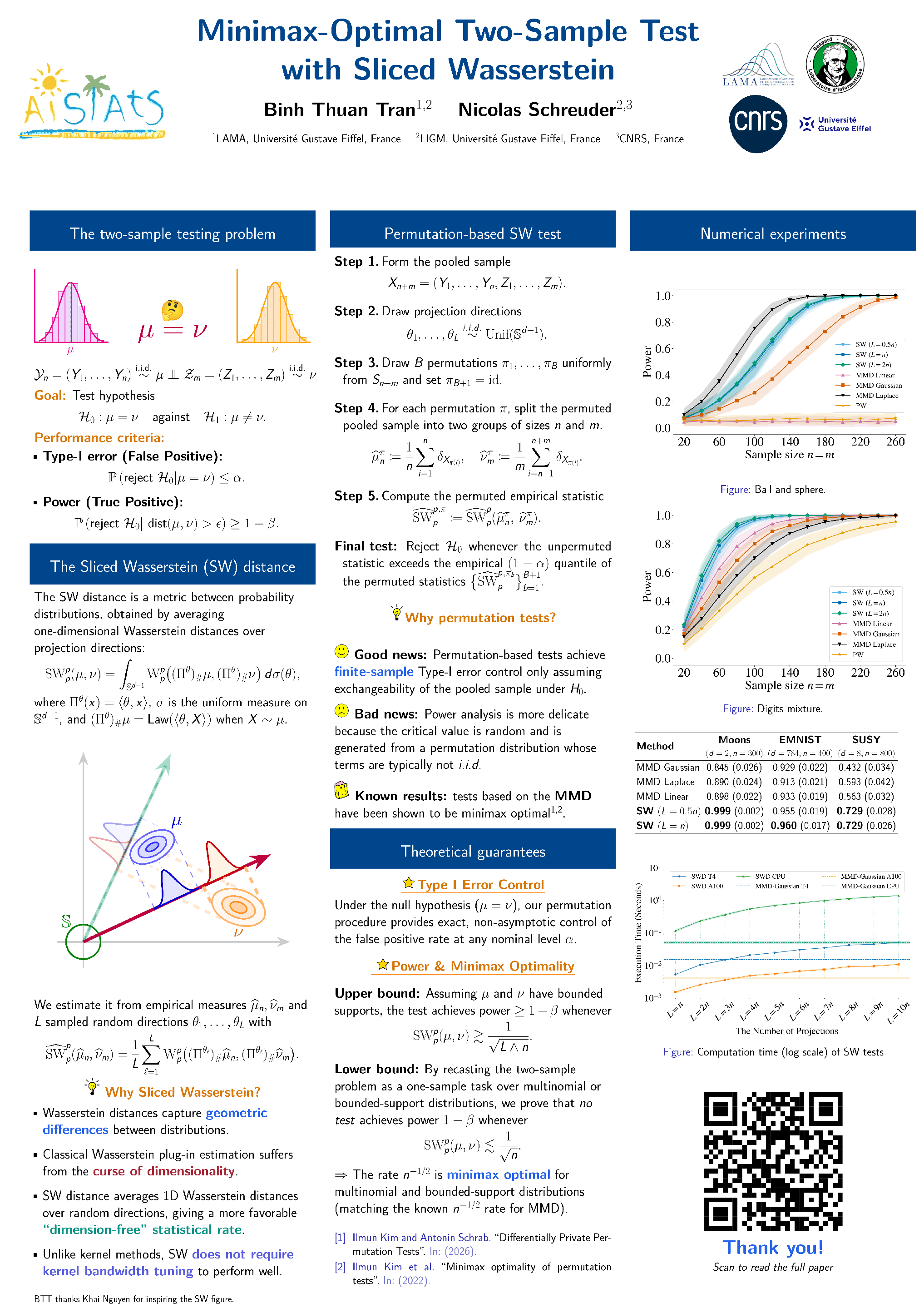
We study the problem of nonparametric two-sample testing using the sliced Wasserstein (SW) distance. While prior theoretical and empirical work indicates that the SW distance offers a promising balance between strong statistical guarantees and computational efficiency, its theoretical foundations for hypothesis testing remain limited. We address this gap by proposing a permutation-based SW test and analyzing its performance. The test inherits finite-sample Type I error control from the permutation principle. Moreover, we establish non-asymptotic power bounds and show that the procedure achieves the minimax separation rate $n^{-1/2}$ with respect to the sliced Wasserstein distance over multinomial and bounded-support alternatives. This matches the optimal minimax rate $n^{-1/2}$ achieved by kernel-based tests with respect to the MMD, while leveraging the geometric structure of Wasserstein distances. Our analysis further quantifies the trade-off between the number of projections and statistical power. Finally, numerical experiments demonstrate that the test combines finite-sample validity with competitive power and scalability, and---unlike kernel-based tests, which require careful kernel tuning---it performs consistently well across all scenarios we consider.
Chat is not available.
Successful Page Load