
SiGHT: A Self-Supervised Graph-based Hallucination DeTection Framework for Domain-Specific LLMs
Abstract
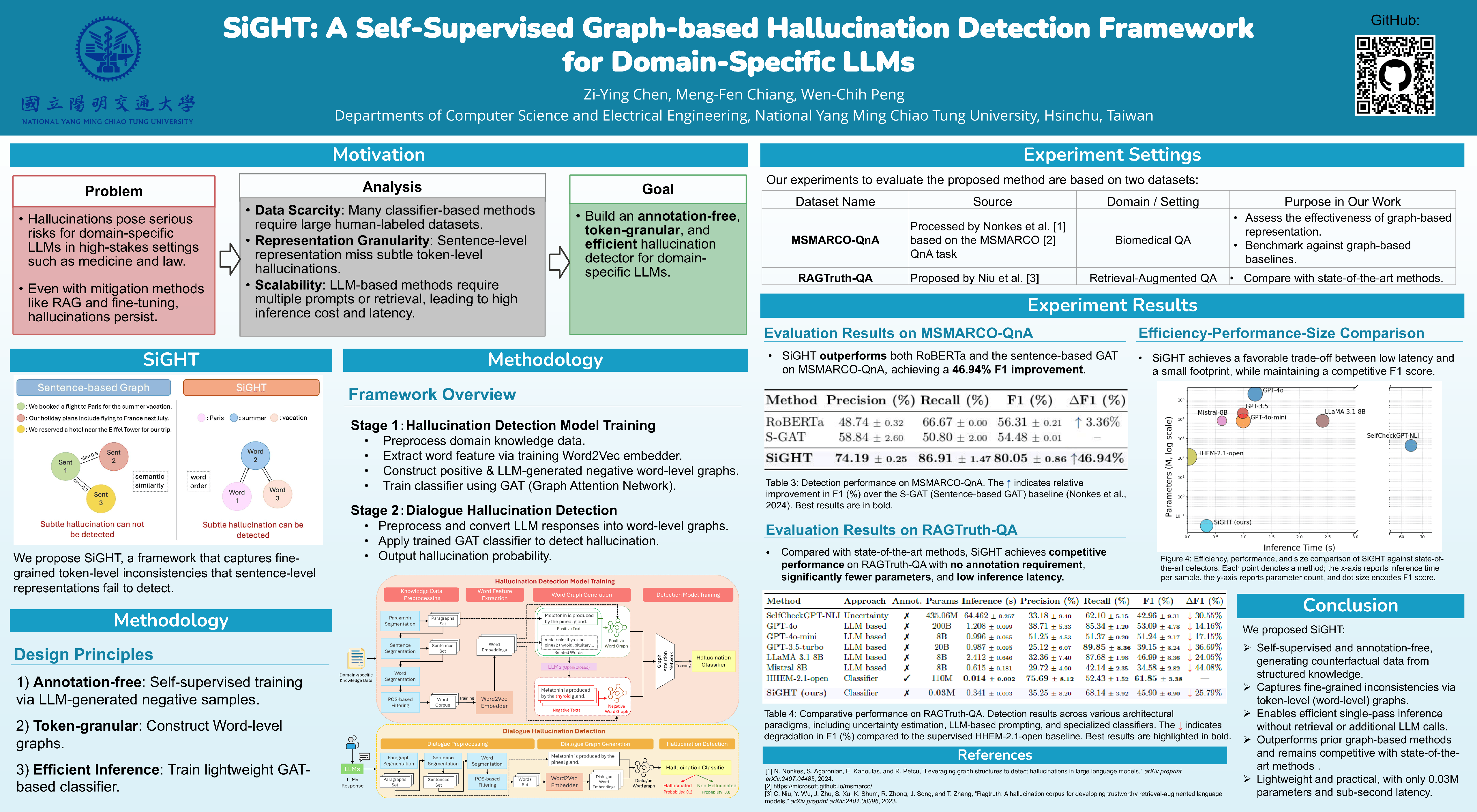
Factual reliability in domain-specific Large Language Models (LLMs) is paramount in high-stakes applications where incorrect outputs carry significant risks. Current detection methodologies often rely on expensive retrieval validation or labor-intensive manual annotation, creating substantial barriers to scalable deployment. To bridge the gap, we propose SiGHT, a self-supervised graph framework designed for efficient hallucination detection in specialized contexts. SiGHT introduces an automated training pipeline that leverages prompt strategies to synthesize plausible hallucinated content from structured knowledge, effectively eliminating the need for human labeling. By mapping texts to high-resolution word-level relational graphs, the framework employs a Graph Attention Network (GAT) to model fine-grained semantic dependencies and identify structural inconsistencies. Empirical evaluations on the MSMARCO-QnA and RAGTruth-QA benchmarks demonstrate that SiGHT achieves a 46.94% relative F1 gain over prior graph baselines. Notably, SiGHT remains competitive with state of the art detectors while utilizing only 0.03M parameters and incurring a minimal inference latency of 0.342 seconds per instance. Dominating the accuracy--efficiency frontier, SiGHT delivers a robust and scalable architecture for real-time hallucination monitoring in high-stakes specialized pipelines.