
TESLA: Taylor Expansion of Sinusoidal Learnable Activations
Daehwa Ko ⋅ JaeHyeon Kim ⋅ SeungHyun Ham ⋅ Jay Hoon Jung
Abstract
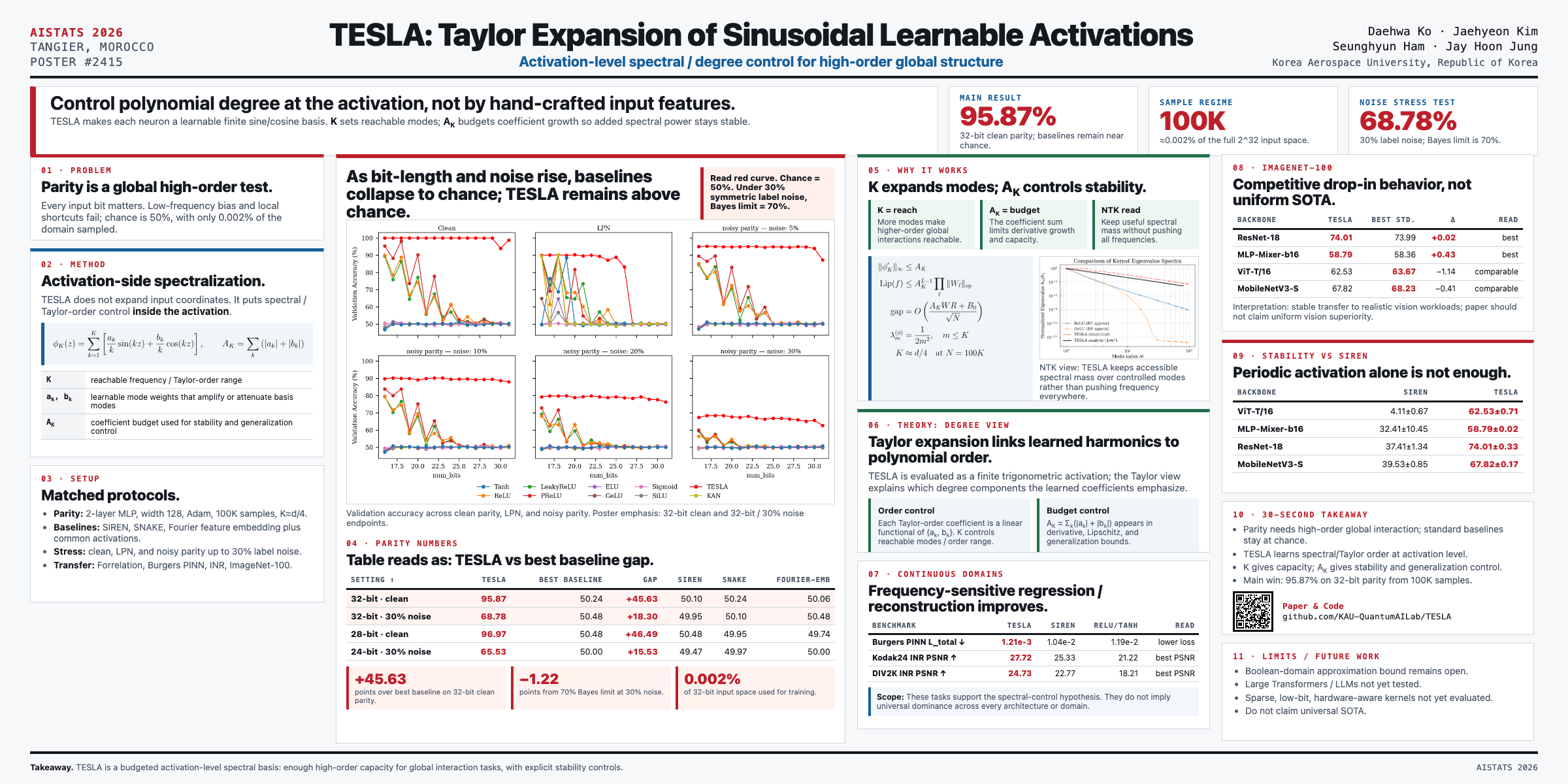
The parity problem—deciding whether the number of ones in a binary vector is odd or even—remains challenging for standard neural networks due to linear inseparability and the need for global interactions. We propose TESLA, an activation defined as a learnable combination of sine and cosine terms, enabling explicit control over polynomial degree and selective amplification of high-order components. Theoretically, we show that constraining TESLA’s coefficients yields Lipschitz/Rademacher complexity bounds and shapes the training dynamics to emphasize higher-frequency structure. Empirically, on parity with input length $n=32$, TESLA attains strong generalization with 100K training samples ($\approx 0.002\%$ of the $2^{32}$ input space) and remains robust under heavy corruption, retaining high accuracy with up to 30\% label noise. We also compare against periodic and frequency-based baselines (SIREN, SNAKE, and Fourier feature embeddings) on parity and Forrelation. Beyond synthetic structure, TESLA delivers comparable performance on ImageNet-100, indicating that activation-level degree control transfers to more general vision workloads. Code: \url{https://github.com/KAU-QuantumAILab/TESLA}
Chat is not available.
Successful Page Load