
Minimizing Human Intervention in Online Classification
William Réveillard ⋅ Vasileios Saketos ⋅ Alexandre Proutiere ⋅ Richard Combes
Abstract
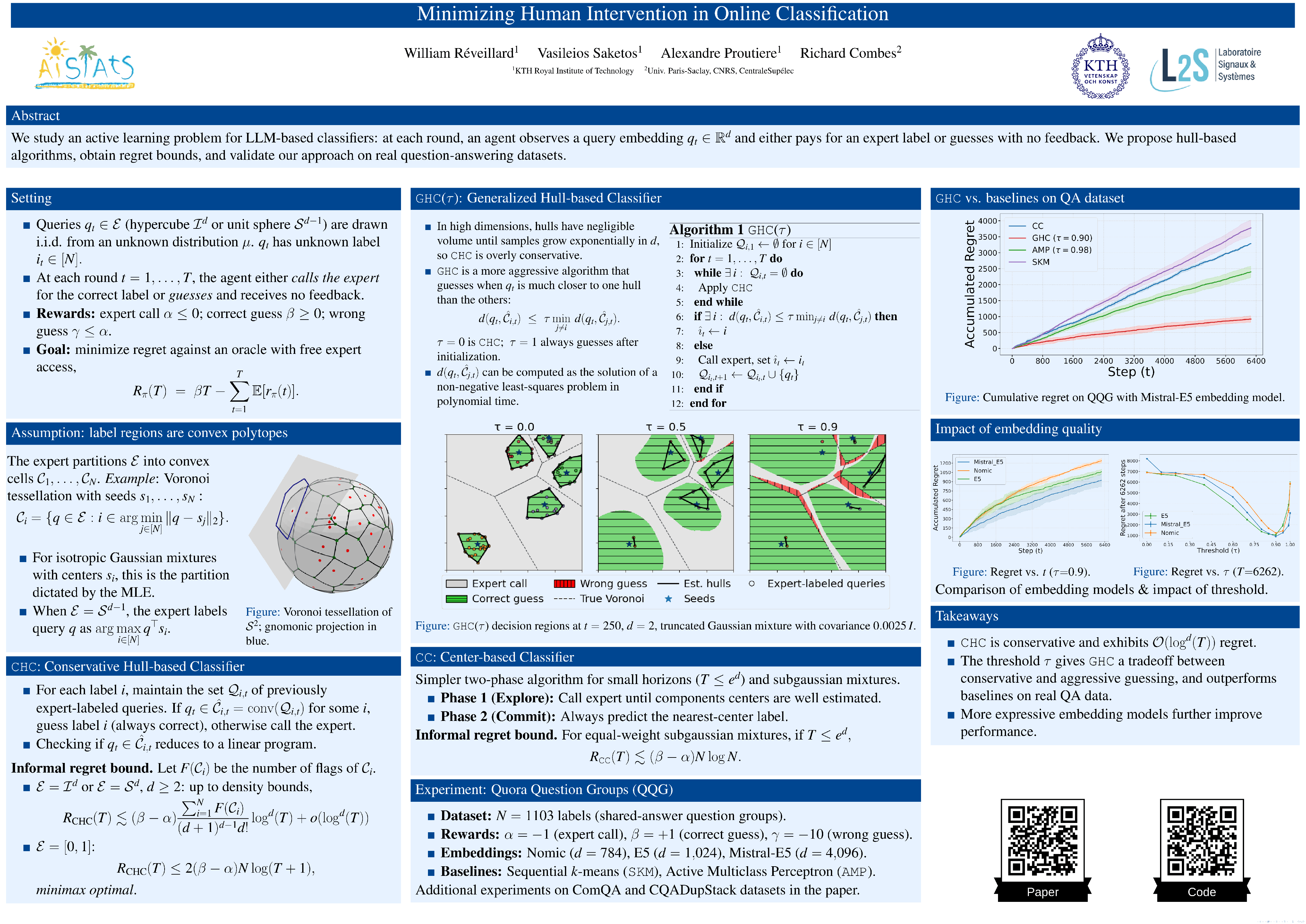
Training or fine-tuning large language model (LLM)–based systems often requires costly human feedback, yet there is limited understanding of how to minimize such intervention while maintaining strong error guarantees. We study this problem for LLM-based classification systems in an active learning framework: an agent sequentially labels $d$-dimensional query embeddings drawn i.i.d. from an unknown distribution by either calling a costly expert or guessing with no feedback, with the goal of minimizing regret relative to an oracle with free expert access. When the horizon $T$ is at least exponential in the embedding dimension $d$, the geometry of the class regions can be learned. In this regime, we propose the Conservative Hull-based Classifier (CHC), which maintains convex hulls of expert-labeled queries and calls the expert when a query lands outside all known hulls. CHC attains $\mathcal{O}(\log^d T)$ regret in $T$ and is minimax optimal for $d=1$. Otherwise, the geometry cannot be reliably learned in general. We show that for queries drawn from a subgaussian mixture and $T \le e^d$, a Center-based Classifier (CC) achieves regret proportional to $N\log{N}$ where $N$ is the number of labels. To bridge these regimes, we introduce the Generalized Hull-based Classifier (GHC), a practical extension of CHC that enables more aggressive guessing via a tunable parameter. Our approach is validated on real-world question-answering datasets using state-of-the-art text embedding models.
Chat is not available.
Successful Page Load