
Fast and Robust Convergence Rate for TD(0) with Linear Function Approximation, Universal Learning Steps and I.I.D. Samples
Ziad Kobeissi ⋅ Eloïse Berthier
Abstract
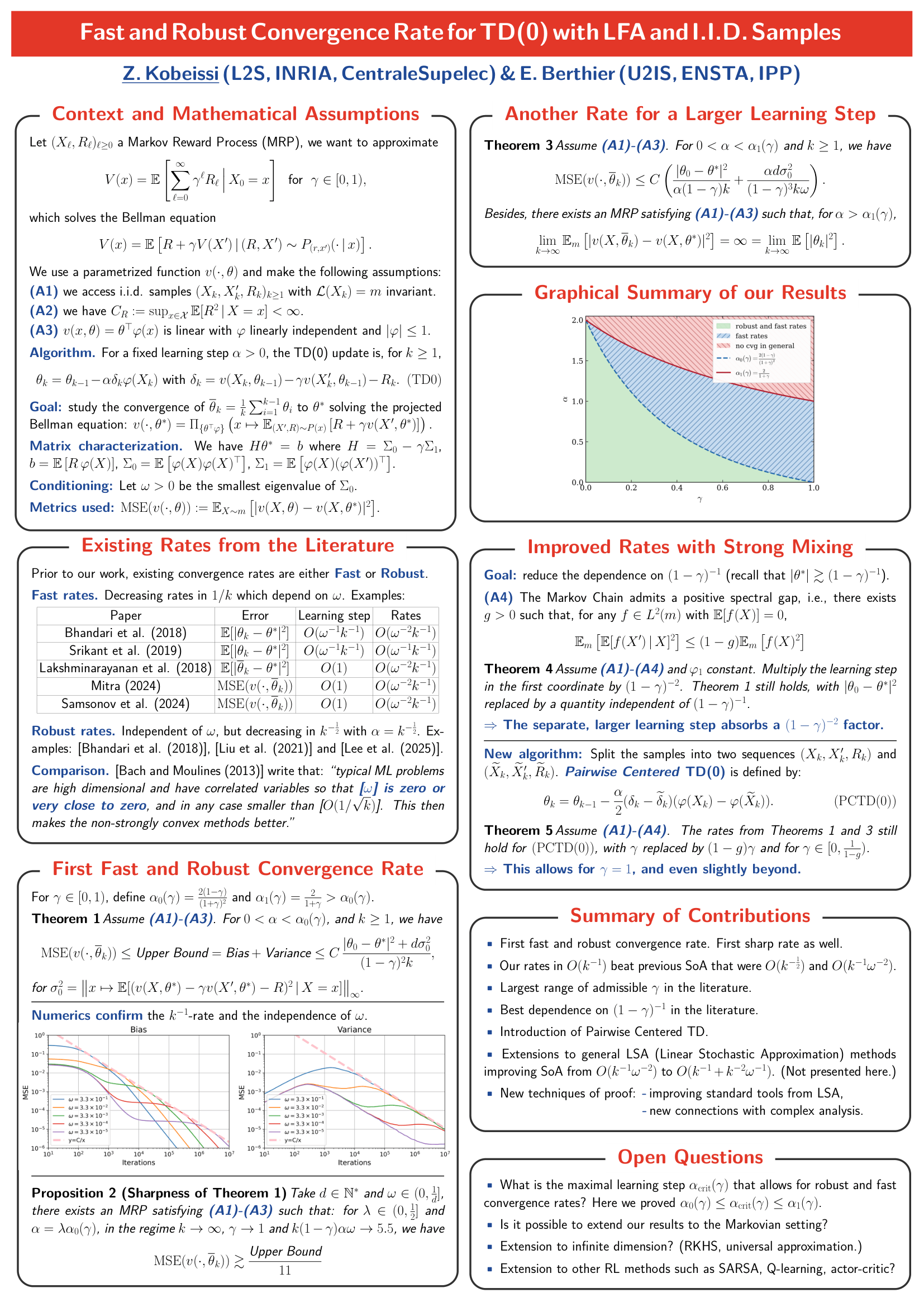
In this paper, we study the finite-time behavior of the TD(0) temporal-difference method with linear function approximation (LFA). We consider on-policy independent and identically distributed (i.i.d.) samples, a constant learning step, and the Polyak-Juditsky averaging method. We establish a new convergence rate, for the Mean-Square Error (MSE) on the approximated function, that is (i) fast in the sense that it admits an optimal dependency in the number of iterations $k$ (i.e., of order $1/k$), (ii) is robust to ill-conditioning: it only depends on an initial error and model-independent constants and (iii) is sharp up to a multiplicative constant lower than $11$. In particular, it does not depend on the smallest eigenvalue of the uncentered covariance matrix of the linear parametrization, unlike all pre-existing $O(1/k)$ rates in the TD(0) literature. We also introduce PCTD(0), a variant of TD(0), which benefits from better convergence properties under an additional assumption of strong mixing on the Markov Chain.
Chat is not available.
Successful Page Load