
Flagging and Desk-Rejection Process – FAQ
This page explains the flagging feature introduced during the AISTATS 2027 review period, and how it connects to desk rejection. It is relevant to Reviewers, Area Chairs (ACs), and Senior Area Chairs (SACs). It complements the Reviewer Guidelines and the AC Guidelines.
What is Flagging?
- What is the flagging feature?
- With a record number of submissions this year – almost 4,000 – the Program Chairs introduced an early-flag feature on OpenReview so that Reviewers, ACs, and SACs can report a paper with a particularly serious, well-founded problem. The goal is to let the chairs examine the most problematic cases and, where warranted, desk-reject them before further reviewing effort is spent on them.
- Who can flag a paper, and who can see a flag?
- Reviewers, ACs, and SACs can all flag a paper on OpenReview.
- A flag is only visible to the paper’s AC, SAC, the Program Chairs, and whoever raised it – never to other reviewers or to the authors.
- What kinds of issues should be flagged?
- Flag a paper when you have a concrete, well-founded concern, in particular:
- Research integrity: plagiarism, dual submission, fabricated or manipulated results.
- Ethical concerns: harmful applications, discriminatory bias, privacy violations.
- Incorrect or invalid results: trivial results, fatal errors, or unaddressed fundamental issues. This is a major warning sign, not by itself grounds for desk rejection – such papers should still be reviewed.
- Low-quality or LLM-generated content: unfinished or incoherent writing, missing sections, undefined notation, hallucinated references, undisclosed LLM-generated text.
- Submission-policy violations, including:
- Page-limit or template violations (including undisclosed font changes) – generally lead to desk rejection.
- A missing AI Use Statement; which generally lead to desk rejection; the statement being merely misplaced is left to the AC’s judgment rather than an automatic DR.
- A missing reproducibility checklist – does not automatically lead to desk rejection. (This is because the style file contained a misleading sentence on that point.)
- A major anonymity break (e.g., an author name or identifying link left in the text) – generally leads to desk rejection. A minor, clearly incidental slip (e.g., a stray editing note such as “AD please fix”) is left to the AC’s judgment.
- Remark: A flag is not a substitute for a low score, and should not be used to express disagreement with a paper’s approach, or because a paper is merely weak or not to your taste – reserve it for concrete, well-founded concerns, and use it thoughtfully and with discernment.
- Flag a paper when you have a concrete, well-founded concern, in particular:
What happens after a paper is flagged?
- The AC reviews and investigate the flag. If the AC shares the concern, they recommend desk rejection through the “Desk Rejection Recommendation” button on OpenReview;
- Then, the SAC then confirms (or not) through the “SAC DR Recommendation Confirmation” button, with an optional comment;
- In any case, the Program Chairs make the final decision.
- If along the process, the AC does not share the concern, they reply to the reviewer and make sure the paper still gets enough reviews.
Timeline and Process
Spirit: there is no strict deadline for flagging, nor for desk rejection recommandations. However, our goal is to limit as much as possible the amount of reviewer work spent on reviews of desk rejected papers. To that end, the goal is to coordinate, with the following target dates.
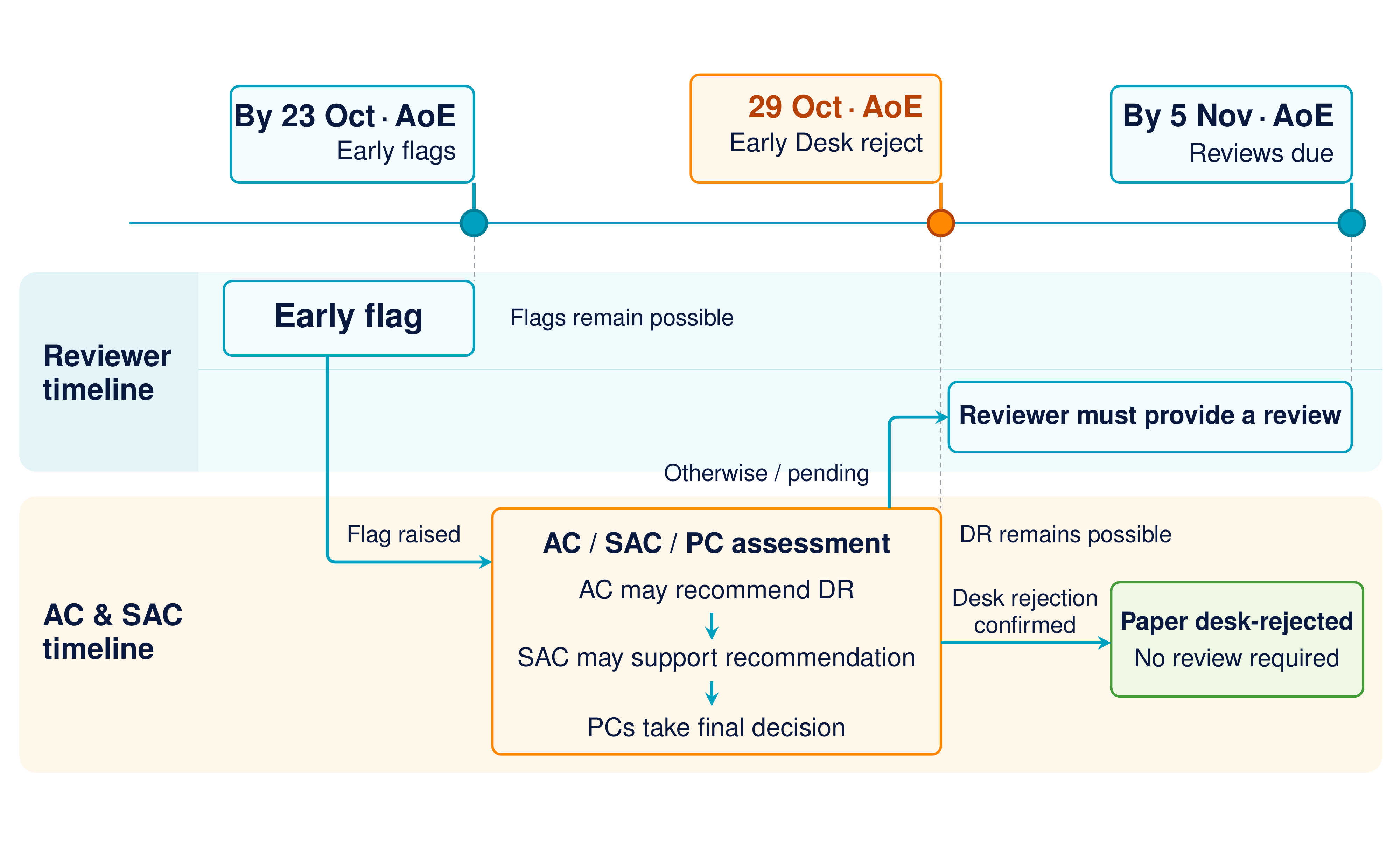
For flags, ACs should try to review them within 2-3 days, and for DR recommendations, SAC and PC will try to escalade and review within the same 2-3 day window.
- When should I flag a paper?
- As soon as possible after your first screening – ideally before Friday, October 23 (AoE). Flagging early gives the chairs time to examine the case and, where warranted, desk-reject the paper before further reviewing effort is spent on it.
- Are October 23 & 29 strict deadlines?
- No. These are the committee’s internal target dates to keep the process timely – not hard cutoffs. Concretely, the committee aims to have ACs assess early flags and submit desk-rejection recommendations by around Oct. 29, and the Program Chairs decide shortly after, around October 29-30.
- Flagging, recommending, and confirming all remain possible after these dates. What changes is the practical likelihood of a desk rejection: once reviewing is well underway, desk-rejecting a paper saves less effort, and reviewers are expected to have proceeded with a full review in the meantime (see below).
- Does flagging a paper replace my review?
- No. Unless a paper is formally desk-rejected, every assigned reviewer is still expected to submit a complete review by the review deadline of November 5, 2026 (AoE). Flagging a paper does not exempt you from writing a full review, which remains essential for the chairs’ decision. Nevertheless, if you have spotted an obvious desk rejection reason (e.g. a completely wrong format), we recommend you to wait a few days, it is likely that the paper will get desk rejected. If the ppaper is DR, you do not need to provide a review.
Desk-Rejection Situations: Quick Reference
This section summarizes the most common submission-policy situations and how they are normally handled. “Desk rejection” below means that the AC should generally recommend it (and the SAC confirm it), while “left to the AC’s judgment” means there is no automatic outcome and the AC decides case by case. In all cases, the Program Chairs make the final decision.
Formatting and template
- Page limit exceeded: generally leads to desk rejection.
- Wrong template, or modified template (including undisclosed font changes): generally leads to desk rejection.
AI Use Statement and reproducibility checklist
- AI Use Statement missing: generally leads to desk rejection.
- AI Use Statement present but borderline or unsatisfactory: left to the AC’s judgment.
- AI Use Statement misplaced (present, but not where expected): not a sufficient reason for desk rejection.
- Reproducibility checklist missing: does not lead to desk rejection, but should be uploaded during the author response period.
Anonymity
- Major anonymity break (e.g., an author name or an identifying link left in the text): generally leads to desk rejection.
- Minor, clearly incidental slip (e.g., a stray editing note such as “AD please fix”): left to the AC’s judgment.
Low-quality or LLM-generated content
- Hallucinations (wrong or fabricated references, repeated text): generally leads to desk rejection.
- Low quality LLM generated text, unfinished or incoherent writing, arguments impossible to follow : left to the AC’s judgment.
Reminder: limited novelty is not a ground for desk rejection, and a flag for incorrect or invalid results is a warning, but not, by itself, a ground for desk rejection.
Guidance for Area Chairs (ACs)
- What should I do when a flag is raised on one of my papers?
- Check the paper:
- For reasons that automatically lead to Desk Rejection, double check the situation
- For reasons that require an in-depth assesment (case "left to AC"), evaluate if you agree with the reviewer's perspective. In particular for LLM-generated or low-quality content, your assesment is key.
- If you share the reviewer’s concern, recommend it for desk rejection as soon as possible through the “Desk Rejection Recommendation” button on OpenReview (the SAC will then confirm).
- Otherwise, reply to the reviewer and make sure the paper still gets enough reviews.
- Check the paper:
- What should not be treated as grounds for desk rejection? As mentioned above
- A paper should not be desk-rejected for limited novelty.
- A flag for incorrect or invalid results is a warning sign, not grounds for desk rejection on its own. Such papers should still go through review.
- A reviewer has declined or can no longer review – do I need to replace them?
- Not systematically. Most papers start with four reviewers, so losing one and still having three is fine. Find a replacement when a paper would otherwise drop below three expected reviews.
Guidance for Senior Area Chairs (SACs)
- What is my role in the flagging process?
- When an AC recommends a desk rejection, you will see a “SAC DR Recommendation Confirmation” button beneath it. Use it to confirm or decline the recommendation, with an optional comment; the Program Chairs make the final decision afterward.
- Please process recommendations as they come in rather than waiting for the target date – the earlier a warranted desk rejection is confirmed, the less reviewing effort is wasted.
- What if I have a concern about a paper that no one has flagged?
- You can flag it yourself, or discuss it directly with the AC.
- What should not be treated as grounds for desk rejection?
- The same two cautions given to ACs apply: not for limited novelty, and not merely because of a flag for incorrect or invalid results – those papers should still be reviewed.
If You Can No Longer Review a Paper
- What should I do if I’m unable to review an assigned paper, or if I notice a conflict of interest?
- Contact your Area Chair immediately so that a replacement can be found in time – do not wait until the review deadline. Write a private comment on OpenReview with the readers set to “AC and above”.
- Please note that nominated reviewers are committed to reviewing the papers assigned to them..